Ten words to learn first
These ten words come up in almost every explanation of the game. Once you know them, rules and beginner sessions become much easier to follow.
Word | Meaning |
|---|---|
Paddle | The solid board you hit the ball with |
Kitchen | The zone 2.13 m on each side of the net. Its official name is the non-volley zone |
Volley | Hitting the ball before it bounces |
Serve | The first shot, which starts a rally |
Return | The shot that hits the serve back |
Rally | Play from the serve until the ball is dead |
Fault | A rule violation or mistake. It ends the rally, and you lose that rally |
Side out | The serve passing to the other side |
Dink | A soft shot from near the net that drops into the other side’s kitchen |
Doubles and singles | A game of two against two, and a game of one against one |
How to read this glossary
The meanings are based on the definitions in the 2026 USA Pickleball Official Rulebook, put into plain language. Where a word is not an official rulebook term, we say so.
Words for the court
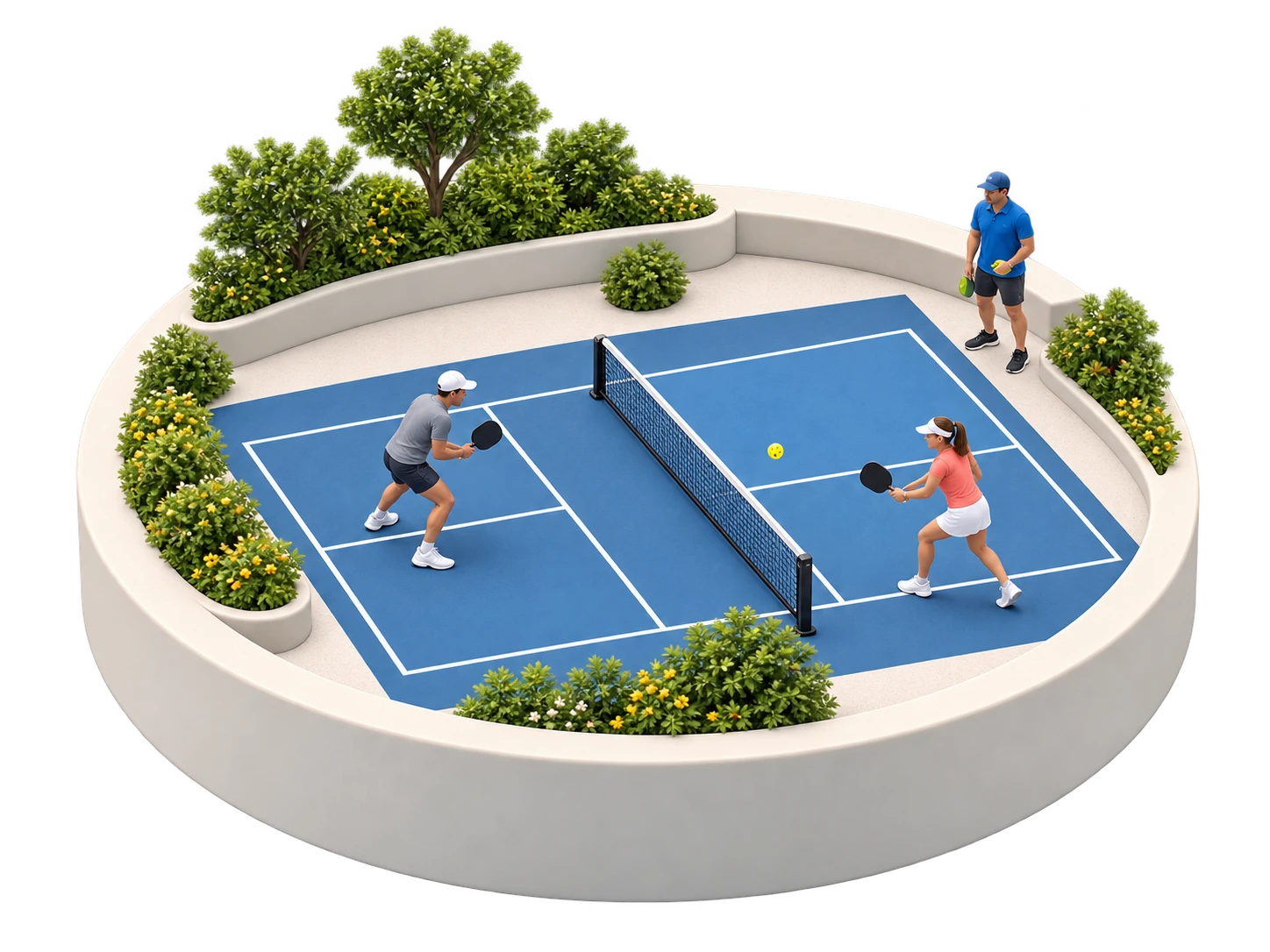
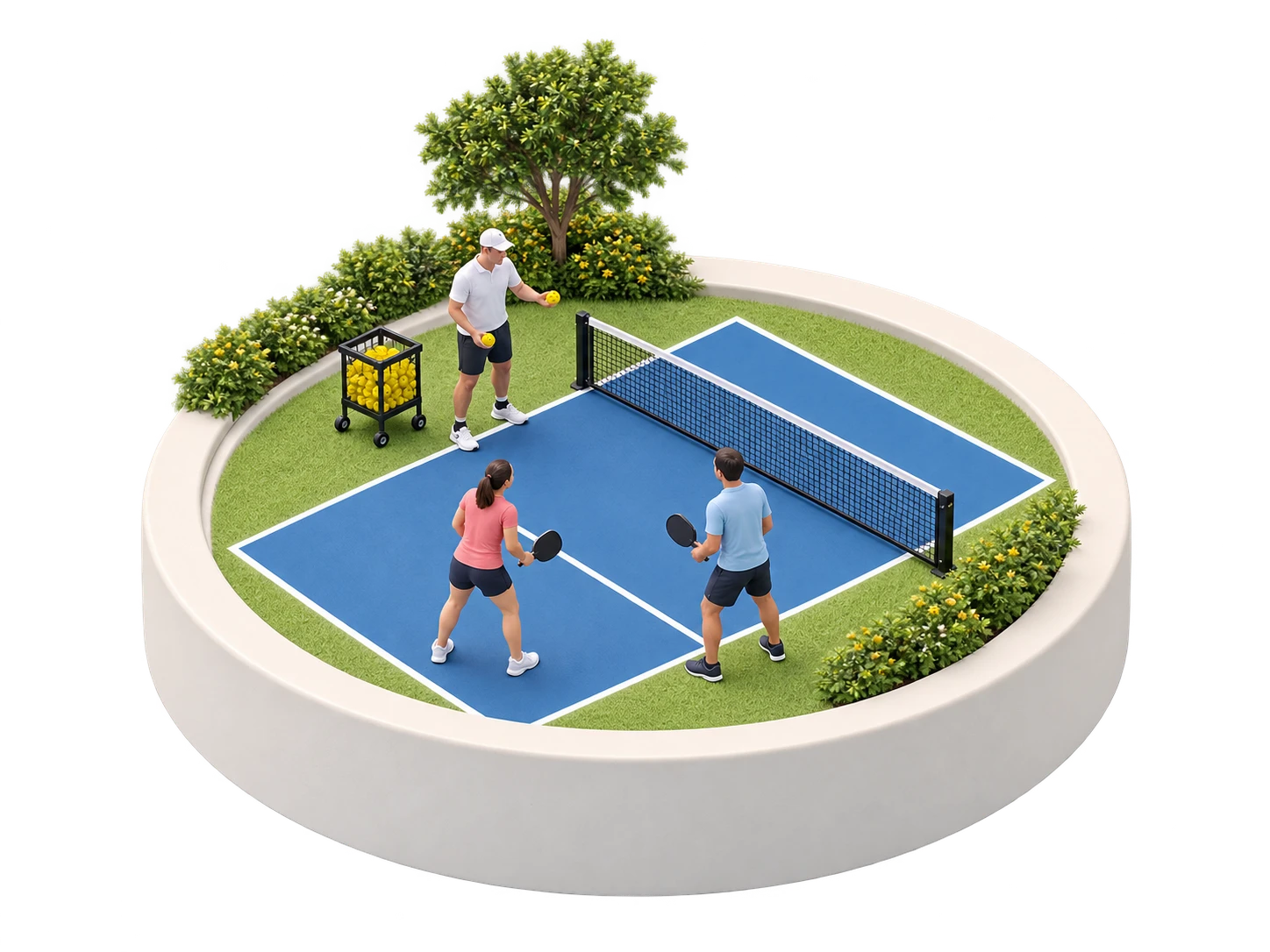
These are the names of the lines and areas. Compare them with the diagram as you read.
Word | Meaning |
|---|---|
Baseline | The line at the back of the court. You serve from behind it |
Sideline | The line on each side of the court |
Centreline | The line down the middle that divides the two service courts |
Net | It divides the court in half. It is 91.44 cm high at the ends and 86.36 cm in the middle |
Kitchen (non-volley zone) | The zone 2.13 m on each side of the net. You must not volley in it |
NVZ | Short for non-volley zone |
Kitchen line | The line at the edge of the kitchen. The line counts as part of the kitchen |
Service court | The left and right areas between the kitchen and the baseline. The serve must land here |
Right and left service court | The service court on the right and on the left as you face the net |
Serving area | The area behind the baseline where you stand to serve |
- “Kitchen” is a nickname. USA Pickleball explains that the non-volley zone is commonly called the kitchen
- The kitchen is not a place you must stay out of. It is a place where you must not volley
Court sizes and rules are explained in our complete guide to basic pickleball rules.
Words for shots
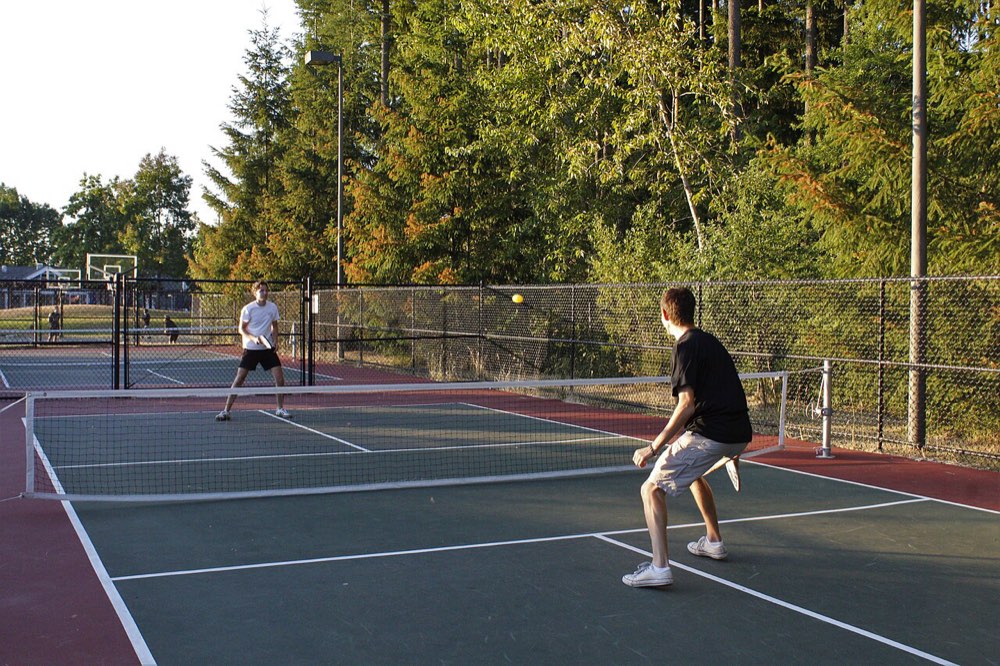
Each way of hitting the ball has a name. Looking at the height and speed of the ball makes them easier to tell apart.
Word | Meaning |
|---|---|
Groundstroke | A shot hit after the ball has bounced once |
Forehand | A shot hit on the side of the hand that holds the paddle |
Backhand | A shot hit on the opposite side from the hand that holds the paddle |
Volley | A shot hit before the ball bounces |
Dink | A soft shot hit after a bounce from near the kitchen. It arcs gently over the net and lands in the other side’s kitchen |
Drop | A soft shot hit from the back of the court that lands in the other side’s kitchen |
Third shot drop | A drop played as the serving side’s third shot. It gives the serving side time to move up to the net |
Drive | A low, fast shot. This is a common word, not an official rulebook term |
Lob | A high shot that goes over the other player’s head and lands deep in the court |
Smash | A hard shot hit downwards from above the head. It is also called an overhead |
Dink and drop: what is the difference?
Both are soft shots that land in the other side’s kitchen. The difference is where you hit them from.
Shot | Hit from | Purpose |
|---|---|---|
Dink | Near the net, around the kitchen | To stop the other side attacking, and to wait for a mistake |
Drop | The back of the court | To give your side time to move up to the net |
To practise these shots, start with our 30-minute first practice plan.
Words for serving and the order of play
These words describe how you serve and whose turn it is.
Word | Meaning |
|---|---|
Volley serve | A serve hit before the released ball bounces |
Drop serve | A serve hit after the dropped ball bounces on the floor |
Server | The player who serves |
Receiver | The player who returns the serve |
First server | In doubles, the player who starts serving from the right side after a side out |
Second server | The first server’s partner, who serves after the first server loses the serve |
Starting server | In doubles, the player each team chooses to serve first at the start of a game |
Score call | Saying the score aloud before you serve |
0-0-2 | The first score call of a doubles game |
In doubles, the score call has three numbers in this order: your score, the other side’s score and the server number. For example, “3-1-2” means your side has 3 points, the other side has 1, and the second server is serving.
Words for scoring and matches
These words describe how points are won and how a match moves on.
Word | Meaning |
|---|---|
Point | One unit of the score |
Game | Normally played to 11 points, and won by a lead of 2 |
Match | The whole contest. The number of games depends on the tournament or event |
Side out | The serve passing to the other side |
Side-out scoring | Standard scoring. Only the serving side scores when it wins a rally |
Rally scoring | A format in which the winner of every rally scores. In the 2026 official rulebook it is a provisional option |
Dead ball | A ball that is no longer in play |
Replay | Playing the rally again, with no point given and no change of server |
Line call | A voice or hand signal that the ball did not land in the required area |
In and out | Whether the ball landed inside or outside the lines. A ball that touches a line is in |
- A ball that touches a line is in. But a serve that touches the kitchen line is a fault
- When there is no referee, players make the calls on their own side of the court
Words for faults
These words name the different kinds of faults.
Word | Meaning |
|---|---|
Fault | A rule violation or mistake. It ends the rally, and you lose that rally |
Double bounce | The ball bouncing twice on one side of the net before it is returned |
Double hit | Hitting the ball twice. It is not a fault if it happens in one continuous swing in one direction |
Carry | Hitting the ball so that it does not bounce off the paddle but is carried along its face |
Kitchen fault | Volleying while in the kitchen or on its line. It is still a fault if your momentum takes you in after the volley |
Momentum | The movement that keeps your body going after you hit the ball |
Hinder | Something not caused by a player that briefly gets in the way, such as a ball rolling in from another court |
Distraction | An action such as shouting or stamping that stops the other side hitting the ball properly |
Technical warning | A warning for minor unsportsmanlike behaviour |
Technical foul | A penalty of one point for extreme unsportsmanlike behaviour |
The situations that count as faults are listed in the basic rules guide.
Words you will hear later
You will hear these words once you have played for a while. You can skip them at first.
Word | Meaning |
|---|---|
ATP (around the post) | A shot returned around the outside of the net post. The rules allow it |
Erne | Volleying right beside the net from outside the court, next to the kitchen. It is not a fault as long as you do not touch the kitchen. This is not an official rulebook term |
Stacking | A way for doubles partners to line up so that each stays on a chosen side. Apart from the server and the receiver, players may stand anywhere on their own side. This is not an official rulebook term |
Open play | A session in which the players who come take turns to play games with different people. This is not an official rulebook term |
Words that are easy to mix up
Some words sound alike but mean different things.
Words | Difference |
|---|---|
Kitchen and non-volley zone | The same place. Non-volley zone is the official name and kitchen is the nickname |
Double bounce and the two-bounce rule | Different things. A double bounce is a mistake: the ball bounces twice on one side. The two-bounce rule says that the serve and its return must each bounce once before being hit |
Volley serve and drop serve | A volley serve is hit before the ball bounces. A drop serve is hit after the dropped ball bounces |
Fault and side out | A fault is one mistake or violation. A side out is the serve passing to the other side |
Dink and drop | Both land in the kitchen. A dink is hit from near the net, and a drop from the back of the court |
Frequently asked questions
Is “kitchen” the official name?
The official name is the non-volley zone. In its summary of the rules, USA Pickleball explains that the non-volley zone is commonly called the kitchen.
What does “0-0-2” mean?
It is the score call at the start of a doubles game. The side that serves first has only one server in its first turn. That server is counted as the second server, so the game starts at “0-0-2”.
How many words do I need before I can play?
The ten words at the top are enough to follow a beginner session. You can learn the rest as you play.
Do the words mean the same as in other sports?
Words such as serve, volley and lob mean the same as in tennis. The rules are different, though. We compare them in pickleball vs tennis, badminton and table tennis.
Where does the name “pickleball” come from?
USA Pickleball explains that it comes from the “pickle boat” in rowing. Read the story in the history of pickleball and how it got its name.
Sources
Sources checked: 14 Oct 2026。 Rules may vary by organizer or competition. Check the latest official sources.