
Pickleball at a glance
Pickleball mixes ideas from tennis, table tennis and badminton. This table shows which sport it is closest to for each point.
Compare | Pickleball | Closest sport |
|---|---|---|
Court size | 13.41 m long × 6.10 m wide | Almost the same as badminton (doubles) |
Net height | 86.36 cm at the centre | Close to tennis (91.4 cm at the centre) |
What you hit with | A solid paddle | Like a table tennis racket, it has no strings |
What you hit | A plastic ball with holes | Unlike any of the three |
Serve | Underhand, with one attempt | Close to badminton |
Points in a game | First to 11, win by 2 | The same as table tennis |
Hitting before the bounce | Allowed, except in one zone | Close to tennis |
Key point
The court comes from badminton, the net from tennis and the score from table tennis. Thinking of pickleball as a mix of the best parts makes it easier to remember.
The sections below compare each point with numbers. Every number comes from the official rules of each sport.
Court size: the same as badminton, one third of tennis
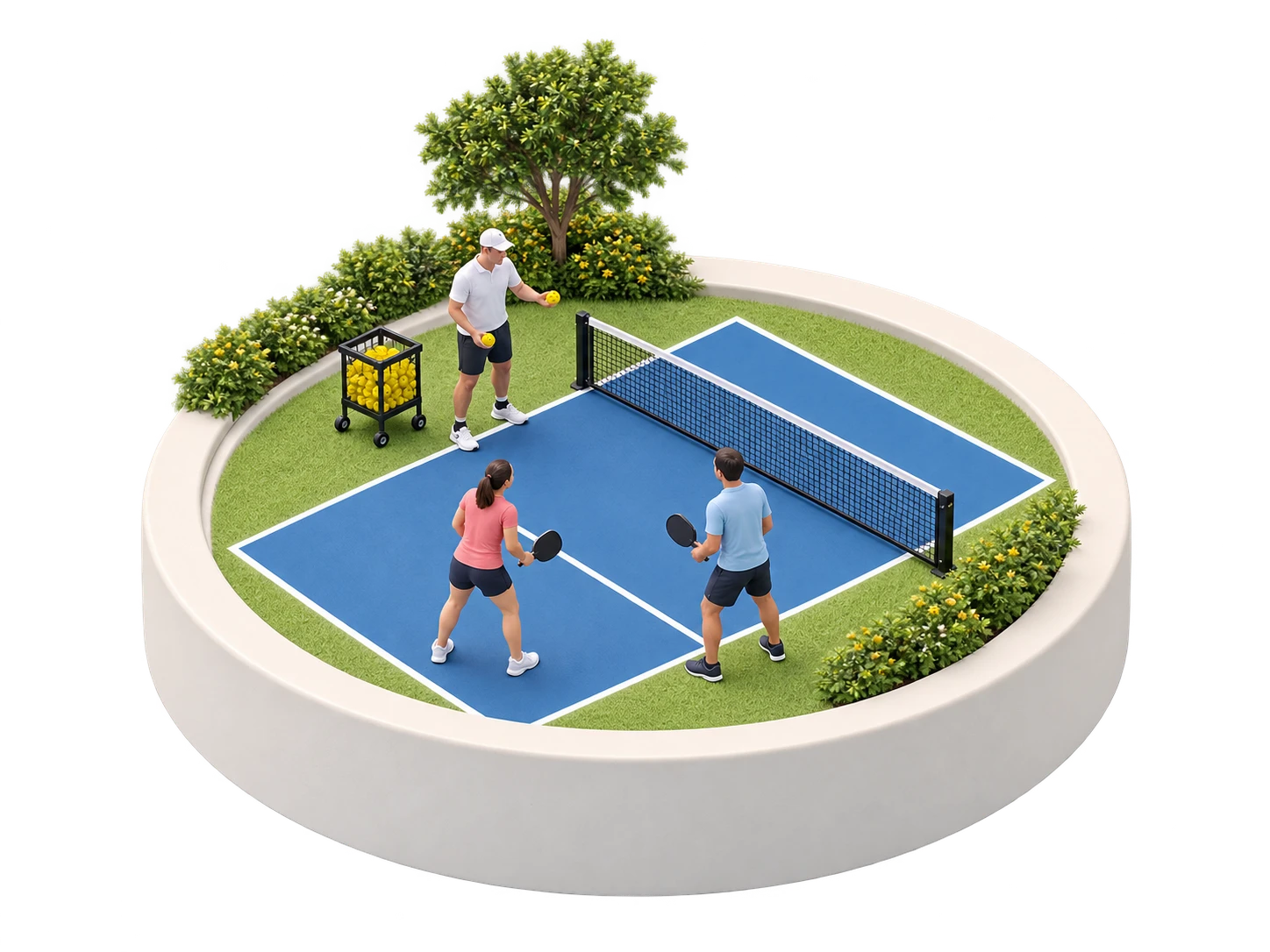
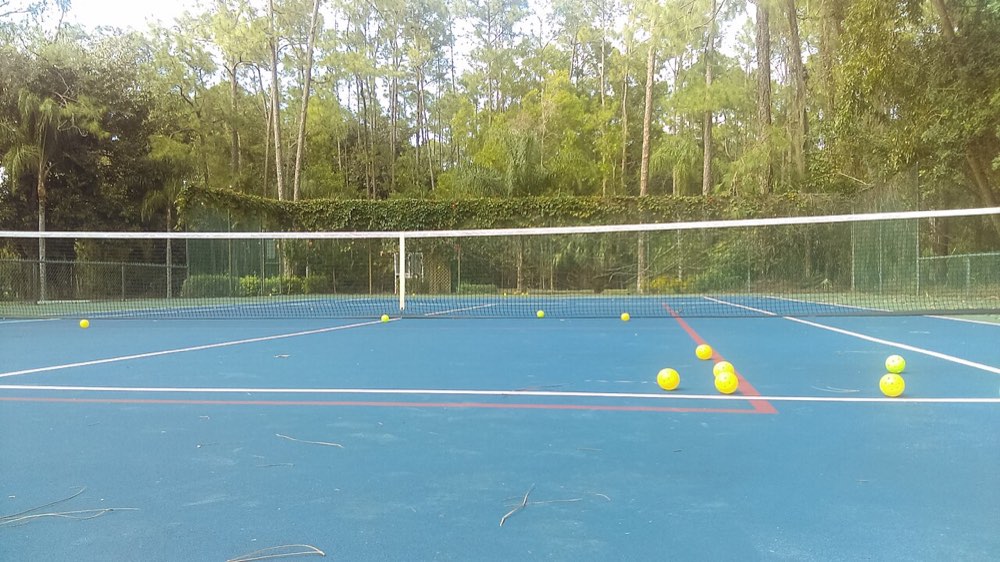
A pickleball court is 13.41 m long and 6.10 m wide. That is almost the same as a badminton doubles court.
Sport | Court size | Area |
|---|---|---|
Pickleball | 13.41 m × 6.10 m | about 82 m² |
Badminton (doubles) | 13.40 m × 6.10 m | about 82 m² |
Tennis (doubles) | 23.77 m × 10.97 m | about 261 m² |
Tennis (singles) | 23.77 m × 8.23 m | about 196 m² |
Table tennis (table) | 2.74 m × 1.525 m | about 4.2 m² |
We worked out each area by multiplying the length by the width.
- A pickleball court is about one third of the size of a tennis doubles court
- Pickleball uses the same court for singles (one against one) and doubles (two against two)
- A smaller court means less distance to run for the ball
Net height: a little lower than tennis
A pickleball net is lowest in the middle, at 86.36 cm. That is about 5 cm lower than a tennis net, which is 91.4 cm in the middle.
Sport | Middle of the net | Ends of the net |
|---|---|---|
Pickleball | 86.36 cm | 91.44 cm |
Tennis | 91.4 cm | 107 cm (at the posts) |
Badminton | 152.4 cm | 155 cm |
Table tennis | 15.25 cm above the table | 15.25 cm above the table |
- A badminton net is more than 60 cm higher than a pickleball net
- In badminton, the shuttle must not touch the floor. In pickleball, the ball bounces, so the net is low
Did you know?
A table tennis table is 76 cm high. With a 15.25 cm net on top, the top of the net is about 91 cm above the floor. That is almost the same as the ends of a pickleball net (91.44 cm).
When pickleball was first played, the net was set at badminton height. You can read the story in the history of pickleball and how it got its name.
Equipment: a paddle with no strings and a ball with holes
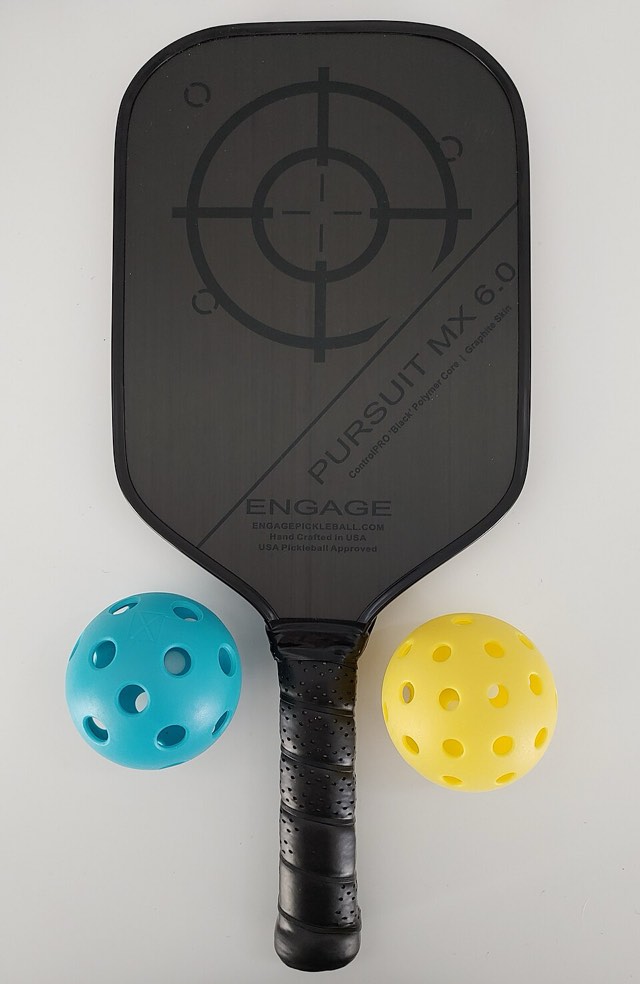
In pickleball you hit the ball with a paddle, which is a solid board. Unlike a tennis or badminton racket, it has no strings.
What you hit with
Sport | What you hit with | Size rule |
|---|---|---|
Pickleball | A paddle (solid, no strings) | Up to 43.18 cm long. Length plus width up to 60.96 cm |
Tennis | A racket (with strings) | Up to 73.7 cm long and 31.7 cm wide |
Badminton | A racket (with strings) | Up to 68 cm long and 23 cm wide |
Table tennis | A racket (a wooden blade covered with rubber) | Any size, shape or weight |
- Comparing the longest allowed lengths, a paddle is about 60 per cent as long as a tennis racket
- Because the paddle is short, you hit the ball closer to your body
What you hit
Sport | What you hit | Weight and size |
|---|---|---|
Pickleball | A plastic ball with 26 to 40 holes | 22.1 to 26.5 g, 7.29 to 7.54 cm across |
Tennis | A ball with a fabric cover | 56.0 to 59.4 g, 6.54 to 6.86 cm across |
Badminton | A shuttle with 16 feathers | 4.74 to 5.50 g, feathers 6.2 to 7.0 cm long |
Table tennis | A plastic ball | 2.7 g, 4 cm across |
A pickleball is a little bigger than a tennis ball, but it weighs less than half as much.
To choose your own equipment, see how to choose your first paddle and indoor or outdoor balls.
The serve: underhand, with one attempt
A pickleball serve is hit with an upward swing. You cannot hit down on the ball from above, as many tennis players do.
Sport | How you serve | Attempts |
|---|---|---|
Pickleball | Swing upwards and hit the ball below your waist. You may also drop the ball and hit it after it bounces | One |
Tennis | Let go of the ball and hit it before it touches the ground | Two (if the first is a fault, you serve again) |
Badminton | Hit the shuttle while the whole shuttle is below 1.15 m from the floor | One |
Table tennis | Throw the ball at least 16 cm straight up and hit it as it falls. It must bounce once on your side and once on the other side | One |
- In pickleball, tennis and badminton, you serve to the area diagonally opposite. In table tennis, you serve diagonally only in doubles
- A pickleball serve goes straight into the other side of the court. It does not bounce on your own side first, as it does in table tennis
Our complete guide to basic pickleball rules shows where the serve must land.
Scoring: first to 11, and only the serving side scores
A pickleball game is normally played to 11 points. At 10–10, play continues until one side leads by 2. Table tennis counts in the same way.
Sport | How a game is won | Who scores |
|---|---|---|
Pickleball | First to 11, win by 2 | Only the serving side, when it wins the rally (standard scoring) |
Tennis | Points go 0, 15, 30, 40. Four points win a game, and six games win a set | The side that wins the rally |
Badminton | First to 21. At 20–20, win by 2 (the 30th point always wins) | The side that wins the rally |
Table tennis | First to 11. At 10–10, win by 2 | The side that wins the rally |
The biggest difference is that only the serving side can score.
- The serving side wins the rally → the serving side gets 1 point
- The receiving side wins the rally → no point. Instead, the serve passes to the next server
There is also a format called rally scoring, in which the winner of every rally scores. In the 2026 official rulebook it is a provisional option that a tournament director may choose. See the basic rules guide for details.
Bounces and volleys: the kitchen in front of the net
Hitting the ball before it bounces is called a volley. Each sport has its own rule about volleys.
Sport | Hitting before the bounce | Special rule |
|---|---|---|
Pickleball | Allowed | The serve and its return must each bounce once. You must not volley in the kitchen, the 2.13 m on each side of the net |
Tennis | Allowed | You must not return the serve before it bounces |
Badminton | Always | The rally ends when the shuttle touches the floor |
Table tennis | Not allowed | The ball must bounce once on your side before you hit it |
Two rules belong only to pickleball.
- The two-bounce rule: the serve must bounce once on the receiving side, and the return must bounce once on the serving side. From the third shot, you may volley
- The kitchen (non-volley zone): the 2.13 m on each side of the net. You must not volley while standing in it. You may step in to hit a ball that has bounced
Because of these two rules, you cannot stand right at the net and smash the ball out of the air.
If you have played another sport: what to watch for first
Players who know tennis, badminton or table tennis often get used to the paddle quickly. But some old habits break pickleball rules. It helps to know them in advance.
If you have played tennis
- The serve is underhand, and you get only one attempt
- The serve and its return must each bounce. After serving, you cannot rush forward and volley the next ball
- You must not volley in the kitchen in front of the net
- The court is about one third of the size, and the paddle is shorter
If you have played badminton
- The ball bounces on the floor, and you may hit it after the bounce
- The net drops from 152.4 cm to 86.36 cm in the middle, more than 60 cm lower
- The outside lines are almost the same size as a doubles court
- Only the serving side scores (standard scoring)
If you have played table tennis
- In some situations, you may hit the ball before it bounces
- The serve does not bounce on your own side. It goes straight to the other side of the court
- “First to 11, win by 2” is the same. But only the serving side scores
- You do not stand at a table. You move around the court to reach the ball
Why people say pickleball is easy to start
USA Pickleball says that part of what makes the sport so popular is how easy it is to learn. It gives these reasons in its guide for new players.
- The rules are simple once you understand the basics
- The two-bounce rule leads to longer rallies and makes the game suitable for all ages
- The kitchen rule stops easy smashes from right at the net, so thinking matters more than power
The numbers in this article point the same way.
Feature | Number |
|---|---|
A small court | About one third of a tennis doubles court |
A light ball | Less than half the weight of a tennis ball |
A short paddle | Up to 43.18 cm long |
A low net | 86.36 cm in the middle |
To get started, read how to start pickleball.
Frequently asked questions
Can I play on a tennis or badminton court?
The outside lines of a pickleball court are almost the same size as a badminton doubles court, and the whole court fits inside a tennis court.
However, the net height (86.36 cm in the middle) and the kitchen lines (2.13 m from the net) must be set for pickleball. Ask the venue whether pickleball is allowed on its courts.
Can I use a tennis or table tennis racket?
Pickleball is played with a paddle that meets the rules. A paddle may be up to 43.18 cm long, and its length plus width may be up to 60.96 cm. Before a beginner session, check whether you can borrow a paddle. Our first session checklist lists what to bring.
Which rules belong only to pickleball?
Among the four sports in this article, these three rules are found only in pickleball.
- The kitchen in front of the net, where you must not volley
- The two-bounce rule for the serve and its return
- Only the serving side scores (standard scoring)
Can children play?
USA Pickleball says the two-bounce rule makes the game suitable for all ages. As the tables above show, the court is small, the ball is light and the paddle is short.
What if I do not know a word?
Words such as kitchen, volley and side out are explained in our pickleball glossary.
Sources
Sources checked: 14 Oct 2026。 Rules may vary by organizer or competition. Check the latest official sources.